The Coffee Shop Question
You’re in a campus coffee shop. Laptop open, textbook ignored.
At the next table a guy says: “You can’t believe in evolution and still be a Christian.” The girl across from him doesn’t argue. She just stares out the window. And maybe that stings — because it’s your tension too.
Every lecture in biology or astronomy stretches the gap between what you’re learning and what you heard in church.
You don’t want to ditch faith. But you can’t deny evidence that looks solid. You didn’t sign up for a crisis. You just wanted to pass the midterm.
But now the question won’t leave you:
Can I trust science and still follow Jesus?
The Myth of Conflict
You’ve heard the story: science and Christianity are enemies.
Pick one. Lose the other. But what if that story is false?
Take Francis Collins. He led the Human Genome Project — mapping human DNA, one of biology’s greatest achievements. He also prays, sings hymns, and believes in the resurrection. For him, evolution isn’t a threat — it’s a tool God used in creation. He calls it BioLogos: science explains the how, faith explains the why.
Or Jennifer Wiseman, an astrophysicist who studies star formation. She also speaks openly about her Christian faith, seeing the Big Bang not as a rival to God but as a glimpse of divine artistry.
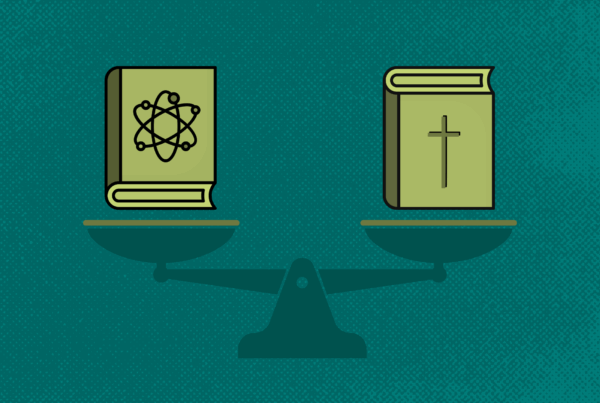
Both insist: science and Christianity aren’t rivals. They’re different lenses on the same reality.
As C.S. Lewis said: we don’t reduce a symphony to vibrations — we receive its meaning.
What if science and faith work the same way? Different languages, one truth.
”Science and Christianity aren’t rivals. They’re different lenses on the same reality.
Why It Feels Like a Tug-of-War
None of this erases the weight you feel.
Maybe youth group warned you that evolution was dangerous. Maybe your professor scoffs at faith as superstition.
Two loud voices. Both saying you can’t have it both ways. No wonder you feel caught.
But the choice isn’t between integrity and belief. It’s between shallow frameworks and deeper ones.
Here’s the deeper one: evolutionary creation.
-
God created the world — and used evolution to diversify life.
-
The Bible is true — but it was never meant as a lab manual.
-
Science explains how we got here — faith explains why it matters.
It won’t erase every mystery. But it gives space for both your mind and your soul.
And it roots belief not in arguments but in a person: Jesus — who entered history, walked on water, wept at graves, and rose again.
A story big enough for intellect and awe.
A Better Way Forward
So — can you be a Christian and believe in evolution?
Yes.
You can love Jesus and respect fossils. You can affirm resurrection and trust genetics. You can hold Scripture in one hand and a telescope in the other. And you won’t be alone. Across campuses and labs, more Christians are rejecting false choices. They’re finding that science deepens their awe of God rather than erases it. They’re discovering that real faith doesn’t shrink from discovery — it invites it.
So the next time a lecture makes you wonder if belief is slipping away, don’t panic.
Stay curious.
Ask harder questions.
Because the God who wrote physics also wrote redemption. The One who set galaxies spinning is the same One who knows your name.
Want to Go Deeper?
The Language of God — Francis Collins
BioLogos.org — “How could humans have evolved and still be in the Image of God?”
Subscribe to Wonderology + free mini-series: Everything From Nothing