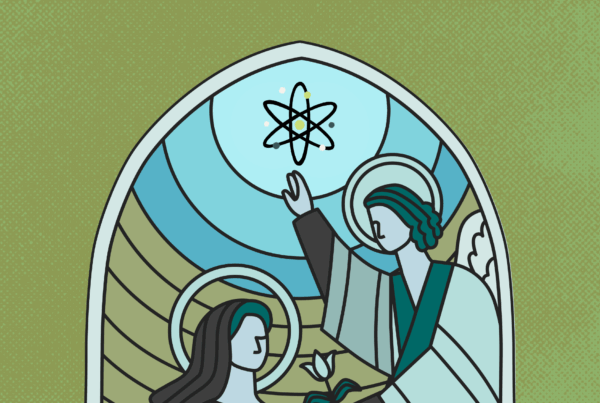

You’re in biology class. Fossils fill the slides. DNA spirals across the screen. Galaxies stretch back billions of years. And in the back of your mind, you still hear it: “Evolution is a lie.”
So which is it? Do you have to choose between science and Scripture? Between Genesis and genetics? Between evidence in the lab and faith in Christ?
Here’s the reality: according to some surveys, about 99% of scientists affirm evolution. Yet roughly between 37-60% of American Christians reject it. That tension is real.
Over the past century, five main views have taken shape. Each tells a different story about life, the Bible, and God’s role in it. Some resist science. Some embrace it. Some try to split the difference.
Here’s the spectrum — and why it matters for your faith.
”About 99% of scientists affirm evolution. Yet roughly between 37-60% of American Christians reject it. The tension is real.
1. Young Earth Creationism
What it says: The earth and universe are about 6,000 years old. Genesis is straightforward history: six 24-hour days of creation, a recent global flood, and a young human race.
Genesis: Read as literal, chronological history with scientific reliability.
The catch: Critics argue that this view requires rejecting the mainstream conclusions of modern science in fields like cosmology, geology, and evolutionary biology. Critics note that when students later encounter the evidence, many struggle with deep tension between faith and science. For many believers, though, this view still feels faithful—trusting God’s Word over human theories, even when the cost is high.
2. Old Earth Creationism
What it says: The universe and earth are billions of years old, but evolution does not explain life’s diversity. God created species in distinct stages across geological time.
Genesis: The “days” in Genesis 1 are understood as long eras, not 24-hour periods.
The catch: Critics argue that this view accepts astronomy and geology but rejects evolutionary biology. That selective approach raises questions — for example, how to account for fossils that show shared ancestry. For many Christians, though, this view offers reassurance. It preserves a high view of Scripture while easing the clash with modern cosmology and geology, holding onto a God who actively shaped life in distinct creative acts.
3. Intelligent Design
What it says: Life shows evidence of a designer. Features like DNA and molecular machines are too complex to arise by chance.
Genesis: Views vary — some read it literally, others figuratively.
Who fits: A wide umbrella. Young Earth Creationists, Old Earth Creationists, and even some who accept evolution but argue natural processes don’t explain everything.
The catch: Critics argue that most scientists consider ID outside the bounds of science. U.S. courts have ruled against teaching it in public schools. Supporters see it as positive evidence for design, but critics argue it relies on using God to explain the gaps in our current scientific knowledge — gaps that tend to close as research advances.
4. Evolutionary Creation (BioLogos & Wonderology)
What it says: God created the world, and evolution was the process he used to bring about life’s diversity. Science explains the how. Faith explains the why.
Genesis: A theological masterpiece, not a lab report. It reveals God as Creator without charting biology or physics.
The strength: This view embraces both Scripture and mainstream science. It resists false choices, helping Christians keep their faith intact when evidence mounts. For many, it expands their vision of Christ—the Word through whom all things were made and in whom all things hold together.
The challenge: Critics argue that adopting this view can require a significant theological reorientation. Readers must re-examine long-held assumptions about which parts of the bible they read as literal as well as the genre of the early chapters of Genesis. It raises real pastoral questions: If all the details in Genesis aren’t literal history, what else might need to be re-read? And how do we distinguish between core doctrine and cultural interpretation?
5. Atheistic Evolution
What it says: Evolution is true, but God is not part of it. Life arises through natural processes alone.
Genesis: Seen as myth or irrelevant.
The catch: Critics argue that while this view aligns with mainstream science on evolutionary mechanisms, it explicitly denies any spiritual or theological dimension. It offers no framework for moral obligation, human value, or cosmic meaning—everything is explained by randomness and natural law. Critics argue that this worldview can flatten the human experience, reducing love, beauty, and consciousness to evolutionary tricks or brain chemistry. For many, this leads to existential disillusionment. Even if the facts stand, the story feels too thin to live by.
Why This Matters
This isn’t an abstract debate. It shows up in real life.
In the student who walks into biology class and feels faith wobble.
In the seeker who wonders if Christianity can survive evidence.
In the parent who doesn’t know what to say when their kid asks about fossils.
Some views build a wall between faith and science. Others tell you to hush when questions come. But one view invites both to sit at the same table.
That’s the heart of BioLogos. Evolutionary creation isn’t compromise. It’s coherence.
It’s fossils that testify. DNA that sings. Galaxies that stretch our sense of time and patience.
The same God who raised Jesus from the grave is the God who wrote life into the code of our cells and set the stars in motion.
A Better Way Forward
So—can Christians believe in evolution? Yes. More than that: seeing evolution as God’s process can deepen faith. Fossils stir worship. DNA sings of design. The age of the cosmos reveals God’s patience and scale.
You don’t have to check your brain at the church door. You don’t have to leave your faith in the lab. You can hold both together.
At BioLogos, we believe this is the fuller, truer way. A way that honors evidence, welcomes mystery, and leads to awe. A way that doesn’t shrink faith—but expands it.
Because the God who wrote physics is the same God who calls you by name.